Hydraulic Hose Repair or Replace: How to Make the Safe, Smart Call
Have you heard of Murphy’s Law of Hydraulics? It says that a hydraulic hose always fails at the worst time.
You’re halfway through a job. The machine is warm. You’ve got people waiting. Then you spot it… a wet sheen on the hose, a drip on the frame, or a fine mist where it shouldn’t be. You need to address it, fast.
Now the question hits:
Do you repair or replace that hydraulic hose?
The right answer depends on how it’s damaged, where it’s failing, and what’s at risk—your machine, your uptime, and your safety.
At Fair Hill Precision, we’ve seen our fair share of hydraulic failures. From hoses to cylinders, we’ve spent years diagnosing, repairing, and even making custom hydraulic hoses and cylinders. We understand your frustration when you spot the first leak.
The good news is, you’ve spotted it, and that’s a start. More good news—you can often repair the hose, which saves you money. So let’s show you how you can make the call on whether you should repair or replace your hydraulic hose.
Let’s break it down in plain English.








TL;DR - Hydraulic Hose Repair or Replace
- Repair is viable when the leak is isolated to the fitting or the hose body is in good condition.
- Replacement is necessary when structural damage is present and indicates imminent failure.
- Common causes of failure include abrasion, heat damage, using the wrong hose for the application, poor routing/tight bend radius, and age/environmental exposure.
- Safety risks, such as high-pressure injection injuries, are a significant risk from tiny pinhole leaks and are considered a medical emergency.
- The cost of planned replacement is almost always cheaper than the cost of a catastrophic field failure, which includes lost production, injury, and secondary equipment damage.
- Professional inspection focuses on predictable failure points to prevent downtime.
Common Reasons Hydraulic Hoses Fail
Most hose failures aren’t random. They’re usually the result of one of these issues:

-
Abrasion
Abrasion is the silent killer. Because hydraulic hoses transport fluids at high temperatures, they’re made up of several layers. The core contains the fluids. The reinforcement layer prevents the core from expanding excessively. The outer layer seals the assembly and protects the hose from damage, serving as a sacrificial layer. Hoses rub on brackets, frames, or other hoses, and over time, the outer cover wears down. If the reinforcement gets exposed, the hose is living on borrowed time.
-
Heat damage
High temperatures cause rubber and thermoplastic hose materials to deteriorate, harden, crack, or lose flexibility, especially near engines, exhaust systems, or hot oil return zones. Like abrasion, it’s not a one-time event, but a series of high-temperature events over time.
If heat is a culprit, you may have other underlying issues, too.
-
Wrong hose for the application
Pressure rating, bend radius, and fluid compatibility matter. Using the wrong hose or the wrong combination of hose and fittings can shorten hose life—and create dangerous failure points.
Selecting the right hose is an exacting science—it’s always good to have someone on your crew knowledgeable on hose compatibility.
-
Poor routing or tight bend radius
Hydraulic hoses tend to be stiff as a result of the layers fused to the core hose.
A hose that’s kinked, twisted, or bent too tightly will fatigue internally, affecting your machine’s performance while showing no sign until the hose fails, so effective hose management is key to your hoses living a long and happy life.
-
Age and environmental exposure
UV, ozone, chemicals, and weather can degrade the cover and weaken the structure. Even if a hose isn’t leaking yet, it may be stiff and brittle.
Bottom line: Most hose problems start small and get expensive when ignored. And then…
…you’re hosed!
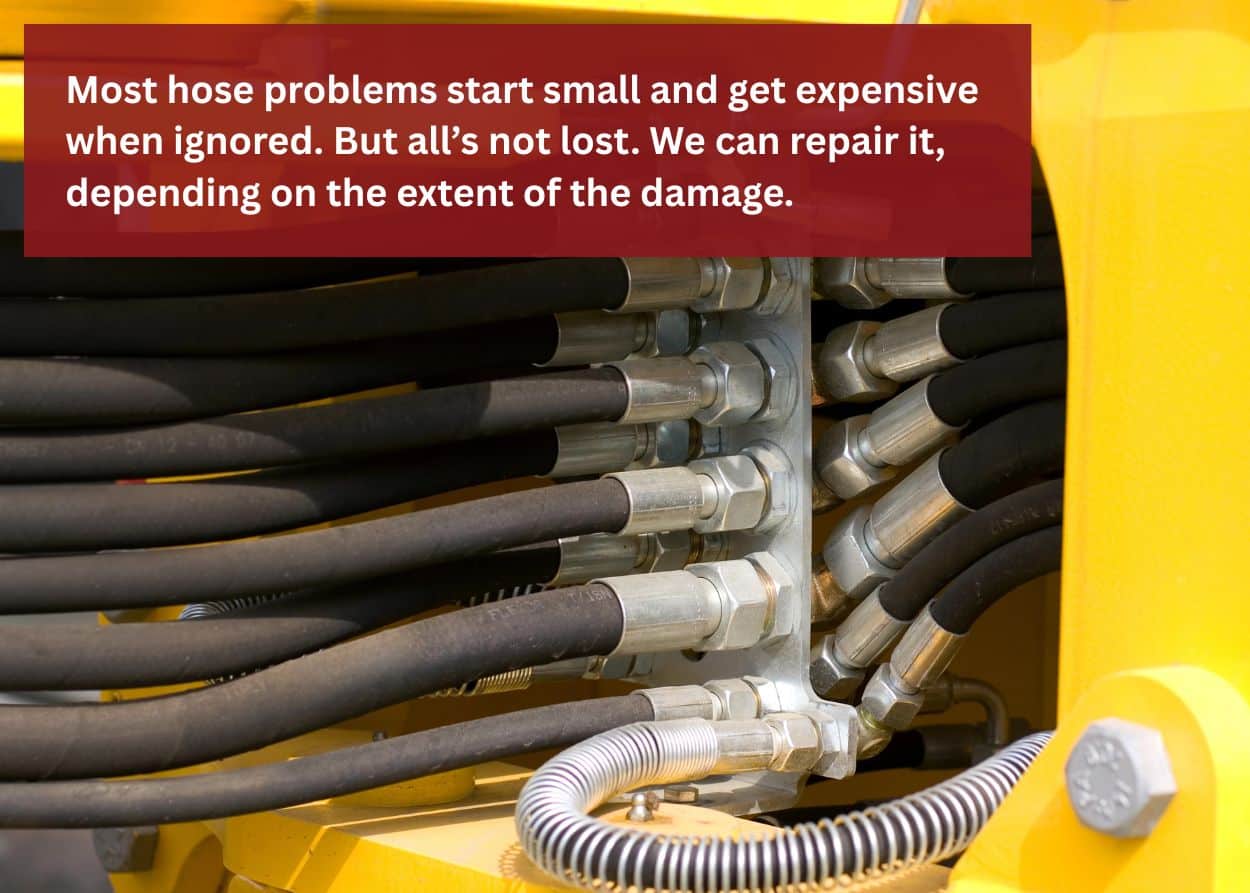
But all’s not lost. We can repair it, depending on the extent of the damage.
When Hydraulic Hose Repair Is a Viable Option
Can you repair the hose? Absolutely, though that depends on where it’s damaged. As we discussed earlier, the pressures that the hose itself goes through means any rupture is grounds for replacement. However, if the hose fitting is damaged, it’s a good candidate for repair.
A safe hydraulic hose repair typically means one of these:
Repair option A: Replace the fitting (re-terminate the hose)
If the hose body is still in good condition and the problem is isolated to the end connection—such as a damaged fitting, seepage at the crimp, or a twisted fitting—then cutting back to the intact section of the hose and installing a new fitting can be a smart move.
This is often viable when:
- The leak is at the fitting, not through the hose cover
- The hose has no deep abrasion
- There are no bulges, blisters, or kinks
- The hose is still flexible (not hard/brittle)
- The hose is not near its service-life end
Repair option B: Correct a routing problem and replace protectants
Sometimes the hose itself is okay, but it’s rubbing or overheating. In that case, the “repair” might be:
- Re-routing the hose
- Adding abrasion sleeves or guards
- Correcting clamps
- Reducing twist
- Replacing the hose (but only if it’s already damaged!)
Repair option C: Temporary emergency measures (with boundaries)
In the field, people do what they have to do.
But here’s the truth: temporary fixes often create bigger problems later—especially if they lead you to keep running a compromised hose.
If you’re doing an emergency fix to get the machine back to the shop, treat it like a spare tire:
- Lower load
- Lower speed
- Minimum operating time
- Replace properly ASAP
Remember—hydraulics are high-pressure systems. If you see a leak, don’t soldier on—fix it quickly!

When Hydraulic Hose Replacement Is the Better Choice
If you see any of the conditions below, replacement isn’t just a best practice. It’s the smart and safe call. Expensive? Likely. But cheaper than a fix you tried to jury-rig yourself? Absolutely.
Replace the hose if you see:
- Exposed reinforcement wire: Once the wire braid or spiral reinforcement gets exposed, the hose has lost its protective layer, and it’s only a matter of time before catastrophic failure. Replace it.
- Bulges, blisters, or soft spots: These can indicate internal damage or separation. This is a failure-in-progress. It’s like driving with a tire with a broken steel belt, and it could blow at any time.
- Cracks, dry rot, or brittleness: If it feels stiff, cracks when flexed, or looks weathered, it’s not trustworthy anymore.
- Kinks or crushed sections: A kink often damages internal reinforcement. Even if it stops leaking, strength may be compromised.
- Leaks through the hose body (not the fitting): A seep, pinhole mist, or wet stripe along the hose usually means the tube/reinforcement has been compromised.
- Multiple issues at once
If the hose is old, routed incorrectly, and showing abrasion, don’t overthink it. Replace it and fix the routing.
A practical rule:
If the hose failure mode is structural, you must replace it immediately. If the failure mode is connection-related and the hose body is healthy, you may be able to re-terminate.
Safety Risks of Delaying Hose Replacement
Finally, we’ll talk about what is at risk.
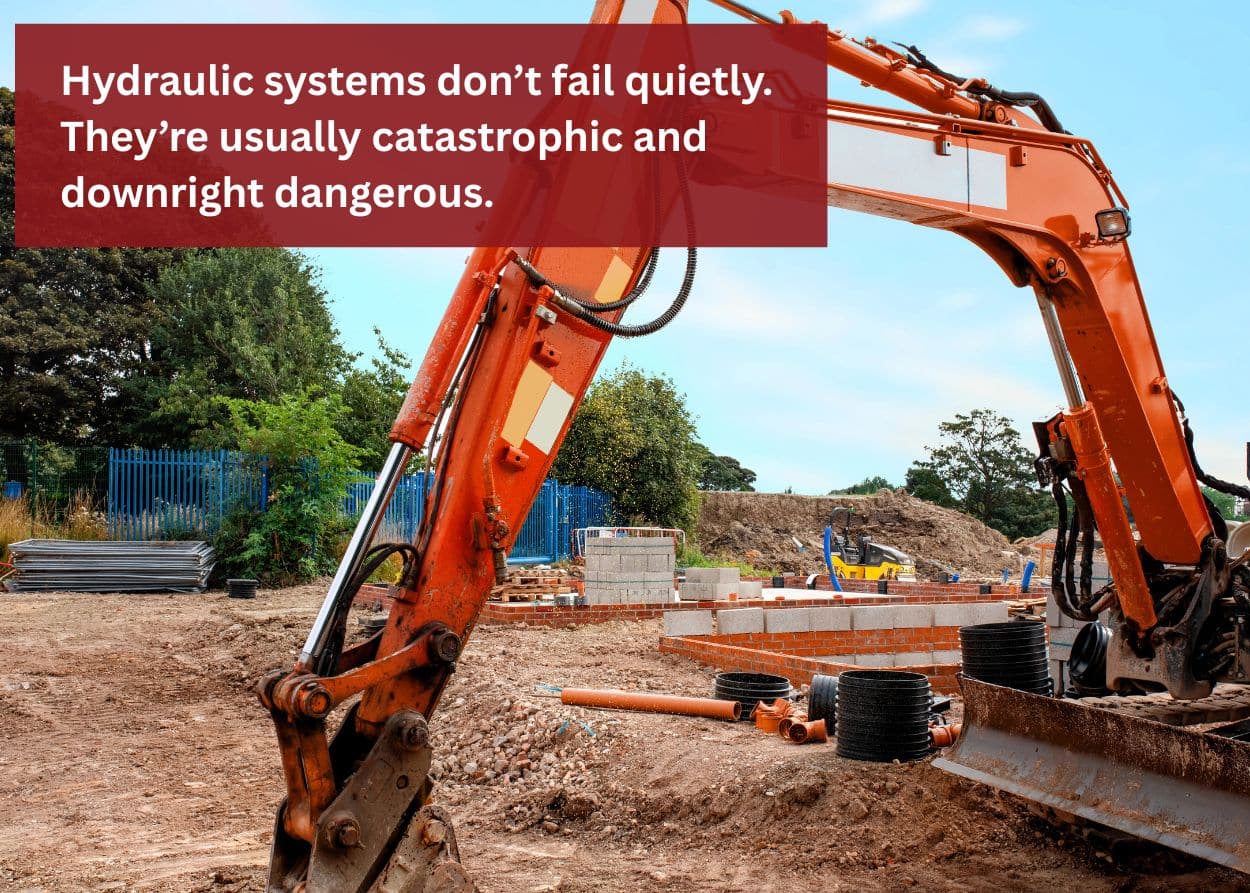
Hydraulic systems don’t fail quietly. They’re usually catastrophic and downright dangerous.
They can fail and result in:
- Whipping hose
- Hot oil spray
- Dudden loss of control
- High-pressure injection injuries.
High-pressure injection injuries: tiny hole, major damage
A high-pressure injection injury is the “tiny hole” that can wreck your hand. A pinhole leak can inject hydraulic fluid under the skin. It may not look serious at first—but it can be a (WARNING: GRAPHIC IMAGES) true emergency. OSHA has documented incidents involving hose bursts and injection injuries.
And beyond injury risk, hose failures can create:
- Fire hazards (hot oil + hot surfaces)
- Slip hazards
- Environmental cleanup costs
- Damage to pumps, valves, and cylinders
If a hose is questionable, the cheapest day to replace it is today.
Because tomorrow is when it fails in the middle of a job.
Downtime vs Cost: The Real Math Most People Miss
People often compare:
- “Cost of a new hose” vs “cost of a repair.”
But the real comparison is usually:
- Cost of failure in the field vs cost of planned maintenance.
Ask yourself:
- What does an hour of downtime cost on your jobsite?
- What does it cost to send someone for parts twice?
- What happens if the hose fails and takes out another component, or worse, a person?
- What if the machine loses function in an unsafe position?
A replacement that feels “expensive” in the shop often looks cheap compared to:
- Lost production
- Rescheduled crews
- Injury
- Secondary failure
As the old saying goes, “you gotta spend money to make money.” And with hydraulic failures, you could stand to lose a lot of money as a result.

How Professional Hose Inspection and Testing Prevents Downtime
The best hose failures are the ones that never happen.
A solid hose inspection process focuses on predictable failure points, not just “does it leak right now.”
What a pro inspection looks for
- Abrasion points and missing clamps
- Heat sources and shielding needs
- Twist and bend radius issues
- Cover damage and reinforcement exposure
- Fitting condition and crimp integrity
- Signs of fluid incompatibility or chemical attack
- Matching hose + fitting systems (avoiding unsafe mixing-and-matching components)
A simple preventive strategy that works
If you’re operating in hard-running conditions such as construction, agriculture, logging, or manufacturing, consider:
- Keeping critical spare hoses on hand
- Building hoses from known, consistent components
- Scheduling hose checks during regular service intervals
Even a quick inspection can catch the “almost failure” before it becomes a mess that stops work.

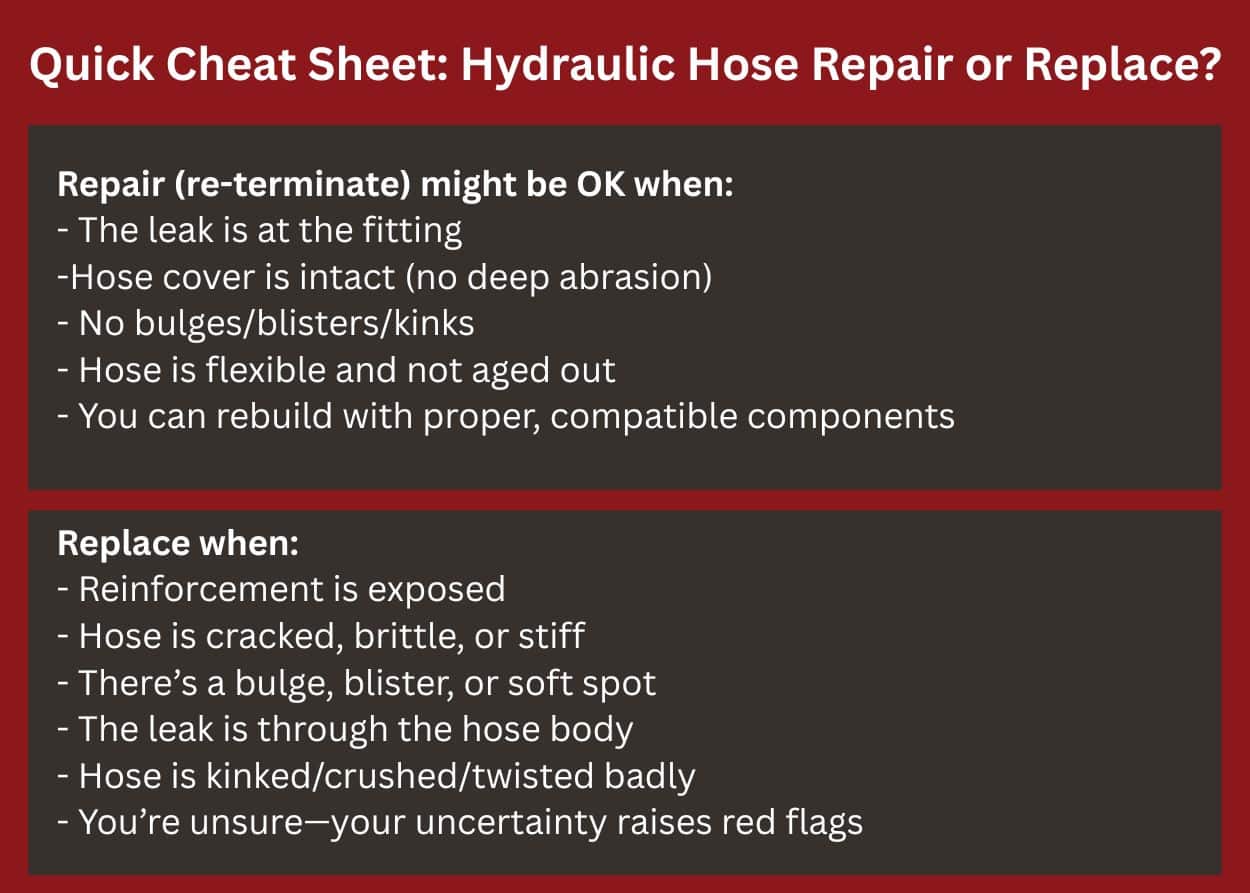
Quick Cheat Sheet: Hydraulic Hose Repair or Replace?
You likely have multiple hydraulic hoses that need to be checked for leaks. Here’s a practical decision guide you can start with:
Repair (re-terminate) might be OK when:
- The leak is at the fitting
- Hose cover is intact (no deep abrasion)
- No bulges/blisters/kinks
- Hose is flexible and not aged out
- You can rebuild with proper, compatible components
Replace when:
- Reinforcement is exposed
- Hose is cracked, brittle, or stiff
- There’s a bulge, blister, or soft spot
- The leak is through the hose body
- Hose is kinked/crushed/twisted badly
- You’re unsure—your uncertainty raises red flags
Above all, be safe. If there’s any doubt or even the slightest hesitation, call a professional to help.
Final Thoughts
Hydraulic hoses are like tires.
You can stretch them longer than you should. But when they go, they don’t go quietly.
If you want fewer breakdowns, fewer messes, and fewer “how did this happen?” moments, focus on two things:
- Replace hoses with structural damage.
- Inspect before the job forces your hand.
At Fair Hill Precision, we’re not just about making sure your hydraulics work. We also ensure your hydraulics are safe while you work. With over 40 years serving the Virginia and Washington DC area, we’ve accumulated a lifetime of experience in parts machining and cylinder rebuilding, ready to assist you with your hydraulic needs.
Contact us—tell us which machine you’re running and the type of hose issue you’re seeing (leak at the fitting, abrasion, bulge, etc.). We’ll help you make the call fast.